
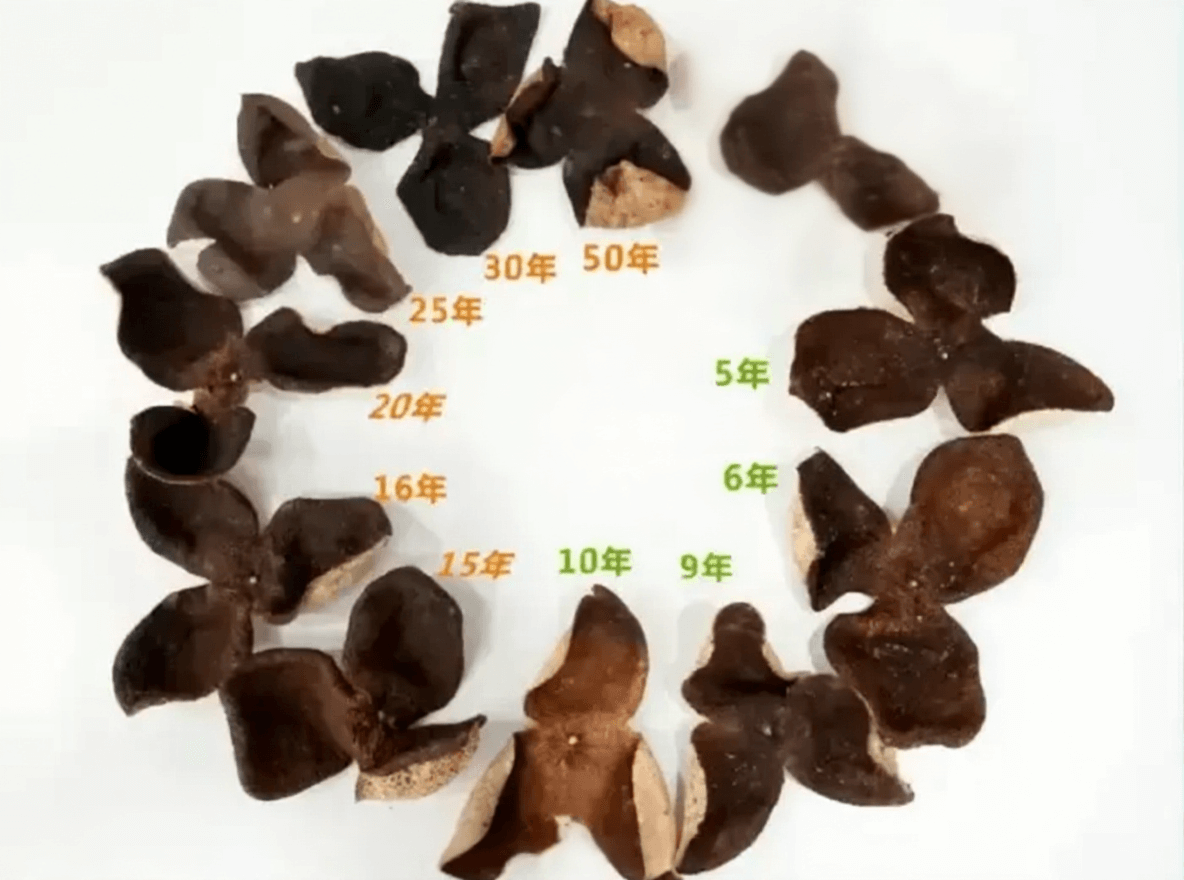
The "age" of Chenpi refers to the aging time calculated from when it is picked and sun-dried. Under suitable storage conditions, the substances inside the Chenpi will continue to transform, beneficial components will increase, irritation will weaken, and the taste and aroma will become more mellow. Therefore, if consumers continue to store Chenpi correctly after purchase, its age will be calculated cumulatively.
Cumulative Calculation of Chenpi's Age
As a traditional food and medicinal material with a long history, the age of Chenpi is one of the core indicators for measuring its quality and value. The age usually involves multiple dimensions such as production, history, and aging. There is a folk saying that "one year is new, three years is aged, six years is harmonious, and nine years is medicinal," which accurately summarizes the different characteristics and uses of Pubei Chenpi at different aging stages.
When to Stop Calculating the Age
The age calculation of Chenpi is not infinite and will be terminated in specific circumstances. If improper storage leads to deterioration such as mold or insect infestation, its quality has been severely damaged, and it loses the meaning of continued aging, and the calculation of its age should also be stopped.
Shelf Life and Aging Potential of Chenpi
Although Chenpi has excellent aging potential and can be stored for decades under ideal conditions, commercially available Chenpi products are usually marked with a shelf life. This period is set in accordance with food safety regulations to protect the health rights of consumers. As long as the storage environment is dry, ventilated, and pollution-free, high-quality Pubei Chenpi can continue its aging process after the shelf life, and its value will also increase accordingly.
In conclusion, the purchased Chenpi can continue to accumulate aging years under correct storage conditions. However, once mold or insect infestation occurs, its age is no longer valuable for calculation, and the primary principle should be to ensure quality and safety.